




 Making Life Easier and Safer for Technicians
Technical innovations are constantly influencing the way blade repair is conducted within the wind sector, as project owners seek to shorten inspection and maintenance times, make the most of short service windows and increase the longevity of their assets by incorporating the latest technology into their strategies. In this article Tom Dyffort, Managing Director of blade repair and inspection specialist Altitec, discusses the five technological advancements that have most influenced the sector over the last decade.
By Tom Dyffort, Managing Director, Altitec, UK
Power Ascenders
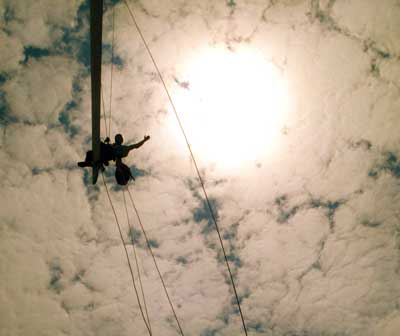
Clambering up turbine towers and along blades would be an infinitely more difficult task without the power ascender systems, such as the ActSafe Ascender, which most rope access blade repair technicians now rely on to carry out a majority of their work. These powered rope ascender systems were first introduced to the industry in 1997, and are currently being rolled out across the European onshore and offshore wind sectors.
These self-powered ascenders allow technicians to use ropes to navigate their way up the turbine tower without needing to manually pull themselves up. The ascenders act as a harness with lock-in rope tools, so the technicians can choose when and where they stop, suspended alongside identified problem areas on the blades or turbine tower. In basic terms, ascenders such as ActSafe are personal elevators for technicians, which they control using a handheld winch system.
 The introduction of this technology has cut time spent on repair works by a third for the average technician, since they can ascend or descend ropes to access blades much more rapidly than before. It also takes much longer before the average technician experiences fatigue when using these devices, given that they no longer rely on their own strength to pull themselves up and down a turbine. Naturally, this also has a positive impact on the overall safety of rope access, minimising the risk of injury from the physical strain of this activity.
Although the ascenders can be petrol powered, they can also be battery powered. If these batteries are charged using 100% certified clean energy sources, then using these systems can be as environmentally friendly as using traditional rope access methods.
Although Altitec uses this kind of technology just for blade technicians, companies such as Siemens are also using it to lift equipment within turbines. This can make complex operations that would otherwise not be possible much easier, since it gives the technicians more flexibility and independence when it comes to repairs.
Having used ActSafe Ascenders for well over a decade at Altitec, it is difficult to imagine working without them, and there is no question that they have revolutionised the way rope access blade technicians are able to work.
Blade Access Platforms
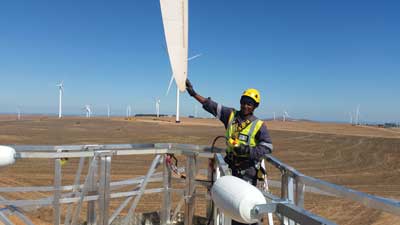
The other form of technology we particularly rely on in the offshore blade repair industry is the Käufer blade access system. This is the only access platform on the market that can be used offshore, and it can be assembled and erected on any surface, rough terrain and offshore included.
The system employs electrical cable winches to manage ascents and descents to and from the turbines, allowing the technician to find an optimum working position. Precise control of these winches allows for safe manoeuvring along the entire length of the rotor blade.
These platforms are wonderfully diverse, with additional components that allow Käufer to use just one system type to access both pitch-controlled and stall-controlled wind turbines. Another benefit of these systems is that they can be set up in just two hours, which, given the narrow time windows in which technicians are often able to work, can make the difference between a job completing on time or dragging on over several days.
 The Cloud
Another, less niche, technological advancement that has significantly changed the way technicians are able to carry out tasks in the blade repair industry is online data storage. Of course, this kind of advancement has affected most industries, in different ways, but perhaps particularly ours. For sharing information between fellow technicians, between technician and project manager, and between technicians and client, there is nothing like it.
Blade repairs often require multiple technicians and their ability to communicate to each other which tasks have been completed and which still need attention, without fellow technicians needing to make site visits, saves time and resources.
The life of project managers is also made much easier, when they can receive regular, visual updates from technicians on the ground. With these systems in place, the client is also able to keep on top of the progress of their project more efficiently. This can make a big difference when it comes to planning for delays and downtime as a result of blade damage.
Smartphones
Our increasingly digital age is revolutionising the way most industries operate. Although cloud storage data play a particularly significant role in a technician’s life, smartphones and their applications, as a more general category, are also making a huge difference to the way blade repair is carried out.
For example, having regular and accurate updates regarding the weather will affect when technicians begin each of their tasks; if they know there is about to be a storm, they will delay heading out to an offshore wind farm to complete repairs. Equally, if they receive an update from their weather app that suggests the weather is likely to be better than expected in a particular window, they might plan to get more done in that period of time, given better visibility and calmer conditions.
Access to GPRS also helps technician teams navigate the more remote sites, and keep in touch with project managers should anything go wrong, or health and safety alerts need to be sent. eSigning documents and online working instructions all contribute to minimising the possibility for error and increasing the efficiency of projects.
Ultraviolet Blade Repair
Looking ahead, another technological advancement likely to play a distinctive role in our industry are the newly developed ultraviolet (UV) blade repair systems. These systems use UV light to cure minor erosions, small holes and surface defects to blades and are designed to be used at temperatures as low as 5 degrees Celsius and in high humidity conditions. This greatly widens the weather windows for carrying out repairs, which in difficult terrain and remote regions can make all the difference.
Of course, this kind of technology is not sufficiently advanced at this stage to replace traditional systems of blade repair, but it does represent an interesting new approach, which, given time, may become a more dominant feature of the wind industry. For example, if it were able to grow, this form of technology could reduce costs for blade repair thanks to its fast curing time, and, particularly in regions where the weather can be temperamental, fixing blades in minimal timeframes helps lower downtime and delay in project operations.
But We Still Need Skilled Technicians
Our industry has developed rapidly over the last decade, alongside incredible advancements in the technological sector, and it is no surprise that one industry has had such an impact on the other. Indeed, as time goes on, we expect to see an increasingly varied array of technical equipment deployed in the blade repair sector.
Naturally this generates considerable excitement and all eyes are on the potential uses of drone and foundation-based camera inspection techniques. However, when it comes down to it and a blade needs repairing, there is no substitute for expertly trained technicians, and the ability to deploy time and cost saving technological innovations to make their lives easier will be a crucial part of driving O&M efficiency in the onshore and offshore sectors.
Biography of the Author
Tom Dyffort is Managing Director of blade repair firm Altitec. He set the company up in August 2001, after a decade in the blade access industry. Headquartered in London and Berlin, Altitec provides a full range of blade inspection, repair and maintenance services throughout the UK and Europe.